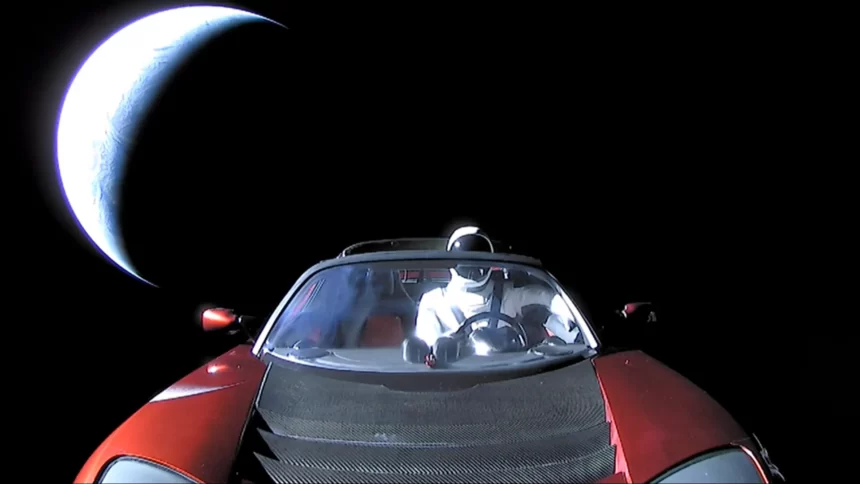
When you’re floating across the icy, hostile confines of space, time does fly. Elon Musk sent his own Tesla roadster into space in 2018 to display how wealthy he is. After five years, he is still wealthy and the Tesla is still circling the skies.
Dummy Payload
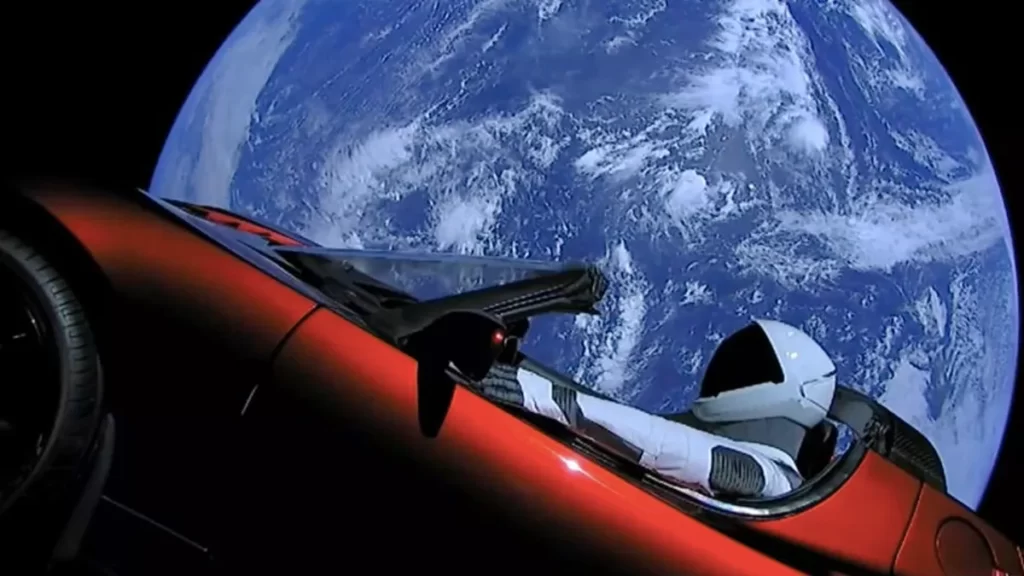
The cherry-colored sports automobile has been in space for precisely five years as of Monday, February 6. To be fair, Musk’s wealth was not the only motivation for Tesla roadster to travel to space, but the fact that he was able to wave goodbye to a pricey automobile in such a concrete fashion doesn’t exactly hide that fact either. The vehicle was sent into space while serving as a “dummy payload” for SpaceX’s Falcon Heavy’s inaugural mission; Musk himself had estimated that the launch’s chances of success were just 50/50.
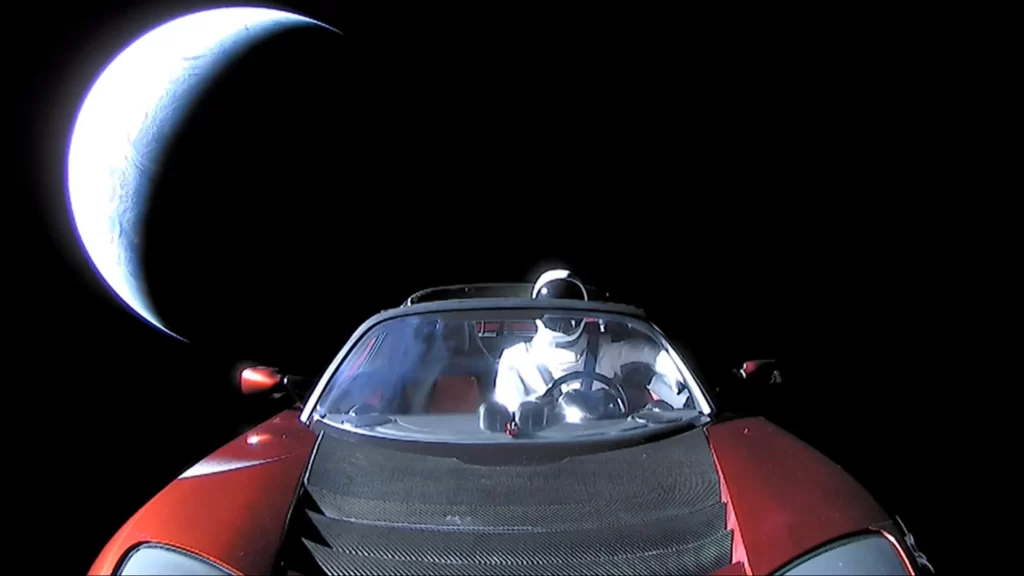
SpaceX stuffed the car with numerous Easter eggs before its 2018 flight. Starman, the spacesuit-clad mannequin behind the wheel, held a placard that said “Don’t Panic,” an allusion to the renowned science fiction novel “The Hitchhiker’s Guide to the Galaxy,” on the dashboard. The works of science fiction author Isaac Asminov are also present on a data storage device, and the names of thousands of SpaceX employees were written on a plaque. Despite the worries surrounding the trip, it was successful, and the Tesla has since been traveling across space. However, everything did go off without a hitch at the launch.
Whereabouts of Tesla Roadster
Following an oblong course that swings as far out as Mars’ orbital path and as close to the sun as Earth’s orbit, the automobile has been circling the sun ever since. Though Mars itself was on the other side of the sun as of Monday, it was just crossing its path. A special website called Where Is Roadster tracks the whereabouts of the vehicle. As of the time of writing, on the afternoon of February 7, the vehicle is 203,276,831 kilometers from Earth and traveling towards us at a speed of 6,646 miles per hour.
The car’s distances from Mars and the Sun are 136,725,234 miles and 280,272,712 miles, respectively; but, as it travels, these distances are continually changing. The website claims that the car has driven 63.2 times around the globe in the last five years, clocking up a fuel efficiency of 20,021.7 miles per gallon in the process.
“Is there Life On Mars?”
To be fair, though, if you don’t have to deal with traffic, hills, or even gravity, it’s a lot simpler to stretch out your fuel supply. The website estimates that the Starman mannequin in the Tesla roadster may have listened to “Is there Life On Mars?” 668,781 times in the other ear while also hearing David Bowie’s “Space Oddity” 496,328 times in the other ear during his journey. Since launch, he has also completed around 3.2797 orbits around the Sun. It’s amusing to picture the robotic spaceman listening to music while floating in the red car, but it’s unclear whether the vehicle is still intact.
Possibilities of its existence
The possibility exists that the object may have been destroyed in a space collision, hit by a meteor, or even fully corroded by radiation. The Tesla roadster has not been directly observed since the weeks immediately following its launch atop a three-million-pound Falcon Heavy rocket in 2018. Only estimated approximations of the car’s trajectory give the most recent data. Since the car doesn’t provide much scientific value, astronomers aren’t particularly motivated to actively track it.
Settlements on Other Planets
A long-standing Musk dream, which also supports SpaceX’s declared goal to populate Mars, is that humanity would someday establish settlements on other planets in the solar system. Musk expressed this desire at the moment of launch. Musk expressed his hope that his “descendants will be able to haul (the roadster) back to a museum” if and when that occurs. The Tesla roadster won’t likely get close to another planet until 2035 when it will sail by Mars once more. Then, according to NASA estimates, it will make two approaches close to Earth between 2047 and 2050.
Additionally, a 2018 academic study put the likelihood of an automobile collision with Earth during the next 15 million years at roughly 22%. It has a 12% chance of colliding with Venus or the Sun, respectively.
Final Thought
We’ll have to cross our fingers that the Tesla roadster smashes into pieces as it slams back into the dense atmosphere if it does end up taking a collision path with Earth. (Spaceborne objects colliding with Earth are rather frequent; most of the time, these items burn up in the atmosphere as they enter. Rarely do such impacts harm populous regions.). The information on the website is assumptions about the automobile’s trajectory, but since we can’t be certain in either case, I advise sticking with the happier metaphor of the floating car rather than a depressing pile of wrecked metal.